Lady Jane Franklin is now mainly remembered as the faithful wife of John Franklin, leader of the ill-fated expedition to find the Northwest Passage in 1845-7. After the expedition disappeared, Jane distinguished herself by her insistence that her husband must be alive, and her organisation of several search parties to find the disappeared – for her efforts, she became the first woman to be awarded the founder’s medal of the Royal Geographical Society in 1860. Her unwavering belief in both her husband’s survival and his conduct (she reacted indignantly to explorer John Rae’s reports that the Franklin expedition had resorted to cannibalism) transformed her into a romantic symbol of constancy. The traditional song ‘Lady Franklin’s Lament’(c. 1850s) imagines her dreaming of ‘Franklin and his gallant crew’ whom she’d ‘cross the main’ to find.
This is probably just how Jane would want it – as Alison Alexander’s 2013 biography notes, Lady Jane Franklin ‘was a genius at public relations’ (ix). She was a prolific writer (the Scott Polar Research Institute Archives in Cambridge alone holds 151 volumes of her diaries), and used her words to paint a picture of the Lady Franklin she wanted the world to see.
As many Victorian women were, she was constantly conscious of her public image; she wrote: ‘I hope I shall never be talked of as one of your bold, clever, energetic, women, fit for anything. I am no doubt possessed of great energy and ardor, but I would rather hide than show it.’
However much she did intend to hide her great energy, it is obvious in two facets of her character – her curiosity, and her love of travel.
Throughout her life, Jane visited a great many countries, often travelling for several weeks at a time; some of her feats include visiting Hawaiian volcanoes, going underground into a mummy-pit in Egypt and a coal-mine in Tasmania, and climbing Table Mountain and Mount Wellington (wearing a skirt, of course!). While Sir John was governor of Van Diemen’s Land from 1837-1843, Jane travelled extensively through Tasmania, Australia, and New Zealand, often without her husband (though never on her own – she needed someone to order about!).
Also during her time in Van Diemen’s Land, she was instrumental in founding the Tasmanian Society (1839), with its delightful motto ‘Quocunque aspicias, hic paradoxus erit’ (‘Whichever way you look at it, this is baffling’). The society held meetings at which papers were read on everything from aboriginal languages, Terrestrial Magnetism, and ‘some sort of rock’. Lady Franklin was not much interested in the more traditional accomplishments of Victorian ladies – an embroidery sampler she stitched as a child amply demonstrates her lack of enthusiasm for needlework. She didn’t have a great opinion of children, either. On the birth of her sister Mary’s child, she notes: ‘I saw a new-born babe for the first time on Mrs Tathams’s lap & thought no object in nature could be less attractive.’
What she did have a great opinion on was her own capability and discernment. ‘I wished people would come to me to ask whom they should marry— I should make a better choice for them than they wd themselves’, she declares. From her private writing, if not so much from her public correspondence, what stands out is her wish to make decisions for herself (and often others), unchallenged. This clearly was part of the freedom she found in travel – in her diary, she writes, ‘I feel every day what a blessing it is to go about independently in my own way without etiquette or observance’.
It seems to me, therefore, that her continued search for John Franklin was perhaps not so much based on a constant wife’s romantic faith in her husband, but on Jane’s belief in her own judgement. She had made a decision about John’s survival and success, and her decisions were surely never wrong. If she is remembered now as the epitome of the supportive, faithful wife, it is because this is the role she chose to inhabit. As Philip Gell, her step-grandson, summarises: ‘She knew where she wanted to get, & she got there.’
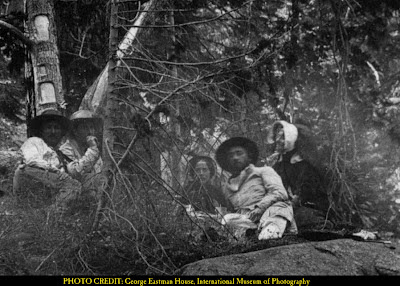
Jane Franklin (far right), at Moss Rock in Yosemite National Park, 1861.
 The Women's Playhouse